

Good afternoon,
This month in one line: Asia–Europe rates are drifting lower as Suez capacity returns, but carriers are pushing back with December surcharges and blank sailings. Chinese New Year falls early on 6 February, so the next three weeks are the time to secure your Q1 space.
The Month in 30 Seconds
🟠 Asia–Europe spot rates slip as November rate increases fail to stick
🔴 Maersk adds a $1,000/40ft peak season surcharge from 1 December
🟢 Suez return gathers pace: three more Gemini services switch from December
🔴 UK ports under pressure: Felixstowe 6 days, London Gateway 5 days
🟠 Reliability stuck at about 50%, so half of all ships still arrive late
Number of the Month – 129%
From early November, ships arriving in North Europe carry 129% of normal capacity, as faster Suez sailings catch up with ships still coming round the Cape (Flexport, 30 Oct).
Core Market Dynamics
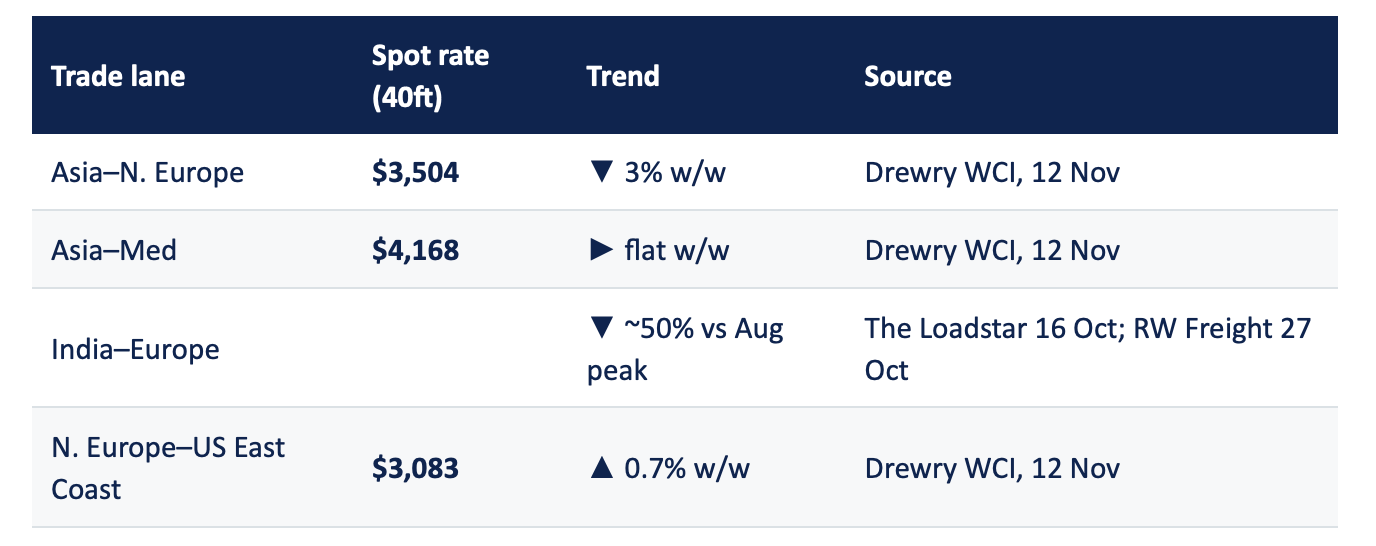
Carriers aimed for about $4,500/40ft to North Europe and $5,000 to the Med from 1 November. The increases didn't stick, and some carriers are discounting to $2,700–3,400 (Linerlytica, via The Loadstar).
Xeneta has Asia–N. Europe at $3,588 (13 Nov), ▼ 3% since 23 October. Asia–Med is▲ 5% over the same period, at $4,666.
Carriers are cutting capacity: space offered from the Far East to North Europe was7.3% lower in 1–13 November than the October average (Xeneta).
December: Maersk adds a peak season surcharge (PSS) of $500/20ft and $1,000/40ftfrom 1 December. CMA, MSC and Hapag Lloyd also announced rate increases from 1 December, as the market enters contract rate negotiations for 2027.
Spot capacity out of India remains relatively healthy following the strong peak season experienced a couple of months ago.
Looking ahead: Xeneta expects spot rates to average up to 30% lower in 2027 and contract rates about 5% lower, as new ships and Suez routings add capacity.
What this means for you: Treat December surcharges as an opening position from carriers, not a certainty. If you're tendering 2027 contracts, avoid locking in long-term rates at today's spot levels, and consider shorter or index-linked terms.
Red Sea, Suez & Middle East
63% of Far East–Europe capacity is back on the Suez route in at least one direction (Alphaliner, 21 Oct).
Maersk and Hapag-Lloyd (Gemini) are moving AE2 (4 Dec), AE3 (20 Dec) and AE1 (14 Jan) from the Cape to Suez. Their ME1 India–Europe service has already switched.
Evergreen resumed Suez transits on 8 November, so every Ocean Alliance member has now returned.
A Suez routing typically saves 10–14 days to North Europe compared with the Cape (Flexport).
The Strait of Hormuz remains volatile. The IMO reports 131 incidents and 25 seafarer deaths, and vessels were damaged on 4, 5 and 7 November. Carriers say continued Red Sea routing depends on security.
What this means for you: Transits will be shorter but less predictable during the switchover, and a vessel can arrive a week or more ahead of its original ETA. Additionally, congestion at European ports could increase significantly over the coming weeks and months, potentially causing further disruption
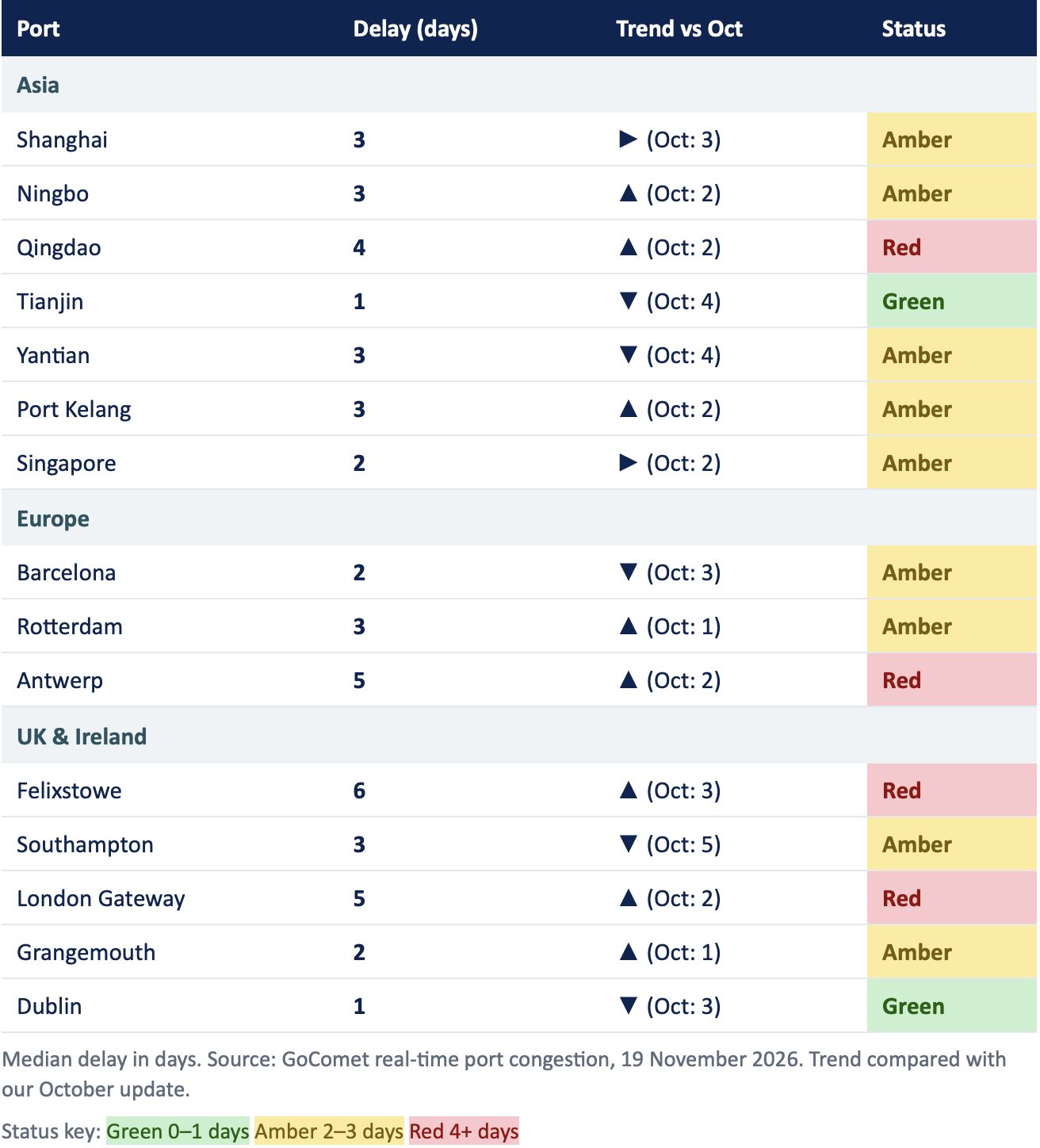
UK: Felixstowe 6 days (up from 3) and London Gateway 5 days (up from 2) are the pressure points. Southampton has eased to 3 days.
Europe: Antwerp 5 days and Rotterdam 3 days are both up, as the first Suez sailings arrive. Rotterdam yards are around 80–90% full (Flexport, 30 Oct).
Asia: mostly 1–3 days. Qingdao (4 days) is the exception, while Tianjin has improved to 1 day.
What this means for you: If your cargo lands at Felixstowe or London Gateway, allow up to a week extra for December deliveries. Ask us whether your carrier also calls at Southampton, and keep a close eye on free time so that delays don't turn into demurrage.
Vessel Schedule Reliability
Global reliability in September was 50.6%: ▲ 0.9 pts month on month but ▼ 14.6 ptsyear on year (Sea-Intelligence).
Late vessels arrived an average of 6.65 days behind schedule: ▼ 0.30 days month on month, but ▲ 1.77 days year on year.
Most reliable: Maersk 64.8%, then Hapag-Lloyd 60.4%. Least reliable: Wan Hai 26.7%.
Alliances (Aug/Sep): MSC 68.9%, Gemini 68.4%, Ocean Alliance 44.8%, Premier Alliance 41.5%.
October figures are due from Sea-Intelligence in late November.
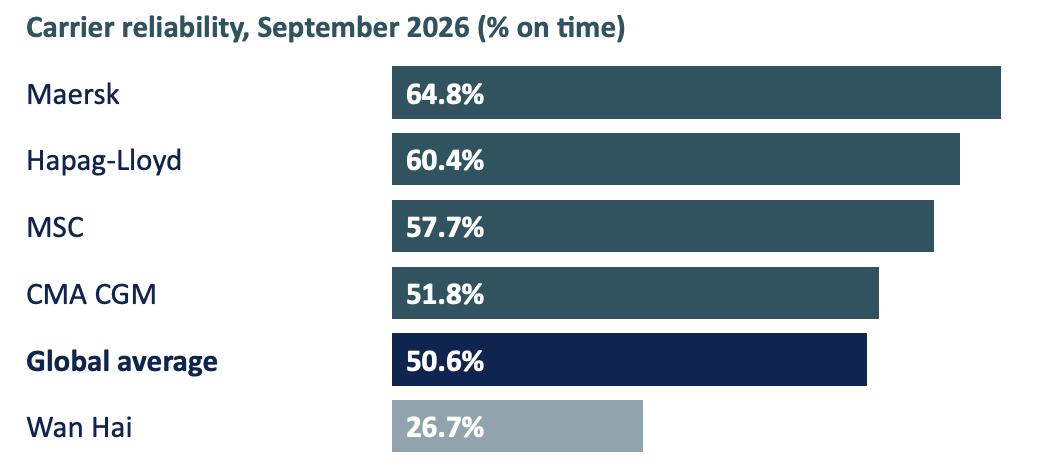
What this means for you: Your choice of carrier matters. There are about 27 points between the most and least reliable alliances, so for time-critical cargo the small premium for a more reliable service is usually worth paying.
On the Horizon (next 4–8 weeks)
1 Dec – Maersk PSS of $500/20ft and $1,000/40ft from the Far East to North Europe
1–14 Dec – FAK rates rising across all carriers as contract negotiation season gets underway.
4 Dec – First Suez sailing for Gemini AE2 (Ningbo)
Mid–late Dec – UK port, haulage and customs Christmas cut-offs [CONFIRM]
20 Dec – First Suez sailing for Gemini AE3 (Shanghai)
14 Jan – First Suez sailing for Gemini AE1 (Shanghai)
6 Feb 2027 – Chinese New Year, 11 days earlier than in 2026. Factories slow down weeks before, and carriers usually blank extra sailings. CNY blank-sailing programmes.
Your Action Checklist
☐ Place CNY orders now and book ocean space at least 4 weeks before your cargo-ready date
☐ Ask for all-in quotes that include the 1 December PSS, valid to your sailing date
☐ Check which of your services are moving to Suez, and update ETAs and delivery promises
☐ Line up customs entries and haulage earlier for December arrivals to avoid demurrage
☐ Review your 2027 contract plans: don't lock in long-term rates at today's spot levels